Saturday, 17 November 2018

How to Achieve Justice for Rohingyas


How to Achieve Justice For Rohingyas

Dr. Mozammel Haque

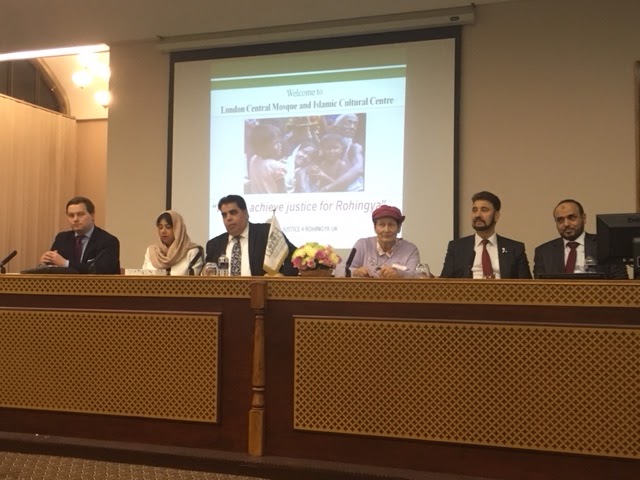
Justice 4 Rohingya UK has organised an event entitled “How to Achieve Justice for Rohingyas” was held at the Library Conference Hall of the Islamic Cultural Centre, London on Wednesday, 24th of October 2018.

Dr. Ahmad al-Dubayan
While opening the event, Dr. Ahmad al-Dubayan, the Director General of the Islamic Cultural Centre & London Central Mosque Trust, said, “The subject we are going to talk about today is very very important. First of all it’s a human issue; it is also a human tragedy which really started long long time ago; that is the crisis or the tragedy of the modern Rohingya of Myanmar.”


Recollecting his memory, Dr. al-Dubayan said, “I remember when I was even student in the University early 1980’s they took us on our visit to India and Bangladesh. That time they planned for us to see in Bangladesh itself. They took us towards south going to Coxes’ Bazaar and Chittagong and in those days we saw the early refugees of Rohingya on the road in Bangladesh.”

“I still remember how awful and how really sad that tragedy that we saw at that time and what is really bothering me around the world now is that the tragedy is still continuing and still going on after all these years.”

Dr. al-Dubayan mentioned, “We are now in the 21st century and many minorities in many countries with democracy there. Time is now to bring this issue of the Muslims of Rohingya in Myanmar and to bring it, not only to do more relief works, to do more relief initiatives, but also to bring justice to them. That’s why we have this organisation, Justice 4 Rohingya UK.”

“If this justice does not or is not initiated and started in the UK I don’t think it would be to start anywhere in the world. UK is very important country which is well known for the voices; the voice of law is very loudly heard by everybody,” said Dr. al-Dubayan and added, “This tragedy really reminds us about the tragedy of the Muslims during the 1990’s of Bosnia tragedy; of the Jews during the days of Holocaust in the 1930’s in Germany and in the early 1940’s. All these things must be stopped and voices must be raised loudly against all these atrocities going and happening around the world.”


Dr. al-Dubayan also emphasized by saying, “Voices must be loudly raised for more human rights, for more rights for these refugees of Myanmar. We are here together today to support really this issue and to extend our hands either with the nations or with human rights organisations or with any other initiatives. It is really something human where all people should come together, not only Muslims, but also other people who are not Muslims and also everybody who believes in justice and believes in equality of human race and mankind.”

Afzal Khan MP
The next speaker was parliamentarian Afzal Khan, the MP of Greater Manchester. He is a strong advocate of Rohingya rights. Afzal has visited the Pakistani Refugees camps in Bangladesh and raised the issues of Rohingya Refugees multiple times in Parliament. MP Afzal Khan started addressing the gathering by saying “brothers and sisters, Assalamualaikum, Good evening, Salam Shalom  Namaste Sastekar.”

Khan said, “Can I say, it is wonderful to see actually so many people here from different backgrounds of different faiths. I know the time is short. I am going to say one or two things very quickly and that more or less my good friend Dr. Dubayan has covered the issue and that is for humanity and we also learnt that for so many decades, violence has been going on on Rohingyas. I also have seen the terrible situation which exists there. Winter is round the corner and you and me are going back home and would have the comfort. These people have none of this. This is our duty, whatever way we can, to alleviate this.”


“You know the United Nations is not the problem. All we need is the weight. It is necessary to raise this issue with the Myanmar government to sort out this problem by accepting Rohingya people as citizens of Myanmar. That’s all we need to do. So that they can carry on their lives like anybody else, like rest of the people of the world as they enjoy,” he said.

Mr. Khan mentioned, “Our government has doing something to help. I think we can do more. Me, Seema Malhotra and many other parliamentarians, we have this opportunity in Parliament to put the pressure on the government. This is one thing; but we also have to do in the UN so that we can do more to carry on doing this.”

Seema Malhotra, MP
Seema Malhotra is also an MP. She is Shadow Chief Secretary to the Treasury in 2016. Parliamentarian Seema said, “Thank you very much. Assalamualaikum and Good Evening to all. I would say huge thank you to you and Dr Ramzy and to all the management committee of hosting tonight and for keeping this issue high on the agenda. This issue has to be kept high on the parliamentary agenda and on our community agenda. And I am incredibly honest on following my friends and colleagues Afzal Khan MP and others who, I know, have been wanted to come and make to come this evening.”

She also mentioned, “You know and we know the scale of this tragedy. 700,000 people fled, destruction of their homes and persecutions in the last year. That is an extraordinary number and when you think about the impact of that, not just on that community; what does it have for Burma? What it means for Bangladesh? Picking up those pieces and then the international community needs to response, not just trying to put plaster on these deep wounds.”

Seema also said, “The United Nations describe them military offensive, The Textbook example of ethnic cleaning and so many still fighting to make for the definition of what is happening. A definition, it should be genocide, in my view, and we should be looking for those who are perpetrators and they should be held accountable in the International Court of Justice.”

“I want to thank you for tonight events for keeping on the agenda and to focus on those who are suffering day by day that here in our community in London. It’s helping to keep up community connected with Parliament and help our Parliament active with other Parliaments and with those international courts as well,” mentioned parliamentarian Seema.


Seema wanted to share a few words that Jeremy Corbyn, the leader of the Opposition Labour Party, has said at Labour Conference recently. She mentioned, “Because I think those spoke of all of us. Sometimes our hopes can be betrayed; many of us campaigned for the release of Aung San Sue Kyi imprisoned by Myanmar military; she was fighting for democracy at that time. We also welcomed her into Parliament; when she spoke and addressed the Houses of Parliament. He went on to say; Myanmar military government with Aung San Sue Kyi normally leads stand accused of these grave atrocities against the Rohingya people. Nearly one million people having fled to neighbouring Bangladesh and women and girls in particular facing appalling violence. That’s why we demand that the Myanmar government ends this horrific ethnic cleansing and allow the Rohingya to rebuild their community and their lives. We ask not anything else.”

“When you think about that number; to me, it is staggering; because when you think about the international aid providing the basic shelter, foods, and medicines; you don’t have to do that; going to humanitarian disaster. It is a human-made disaster; man against man. And with a man-made atrocity of this kind, we see so many sufferings; many who should not suffer,” said parliamentarian Seema.

“They should be able to live their lives in peace and we have to stand up for their return; return when everybody can be living their lives in peace; in peace with each other; in peace with their neighbours and nations; at peace with each other. We have to hold that ideal; because if we don’t campaign for that ideal in the work that we do as citizens and in parliament; we will be failing on our part to see. Thank you everybody for coming.  I wish you all a very very an important evening in which you all come together,” concluded Seema.

Ruth Burnett
Ruth Burnett is a Genocide and Holocaust Educator (Jewish Community). Ruth was born in Berlin 1935 and came to England to escape the atrocities at the age of four. For ten years in different foster homes until she was united with her parents; unfortunately that does not went well. Ultimately she was married living here for about sixty years. She has been a teacher, a psychotherapist and has been a writer for 15 years challenging young people to think widely and challenge injustice. 

Ruth Burnett said, “First of all I want to say thank you for the invitation to come here to speak to you and to hear you of course; thank you for coming to listen. I feel very very honoured to have been invited.”

Ruth Bernett said, “Now I am concerned about Rohingya ever since I first learnt about that tragedy going on and I think it is absolutely appalling. It is genocide; very few people have the courage to face power with truth and acknowledge it is genocide; because if you want to acknowledge it genocide you are bound by law to intervene. That has also so many problems and leaders are shy of acknowledging genocide and having to intervene. It is not going to come from the top to down; it has got to come from the grassroots bottom on more pressures to get the leaders to take responsibility.”

“I go back to apathy, indifference and denial which are much more of a problem than racial conflict, than religious conflicts. Conflict can be resolved with talking through; we seem to have lost the ability to distinguish between conflict and war. War resolves nothing end but create more conflict, more aggression and more vengeance,” she said.

“Every genocide is a huge loss to the whole of humanity. How long we are allowing it to let it go,” said Ruth Burnett and mentioned about a website outlining ten stages of every genocide that has been allowed to happen so far. She said, these genocides “not happened but we allow them to happen in stages; the tenth stage is denial; the ninth stage is the slaughter; there are eight clear stages of genocide. When we know it is happening what we say alleged genocide. We have to face the truth, the power that it is genocide to get it stopped. And it has got to come from the mass of people who are at the moment passive bystanders. This is the challenge the children I speak do a tiny bit of move from being a passive bystanders to being an active bystanders,” she said.

Ruth Burnett also said, “Justice is a word about justice. There are so many concepts; we don’t discriminate between them, justice and punishment. In my view, punishment is not justice; it usually revenge; state-organised revenge; in the penal system. I see justice at exposing what has been a crime; and we need to expose the crime of genocide by exposing everyone in order to be able to see that we are now exposing that what is going on as it is now.”

Robin Marsh
Robin Marsh is one of the Directors for Justice 4 Rohingya UK. He is also Director for the Universal Peace Federation and he is involved in peace and human rights activities for the last 20 years. He works in various issues in partnership with other groups including conflict and sexual violence conflict and genocide awareness and intra-community cohesion.

Rabin Marsh said, “Together with Sheikh Ramzy and number of others we had formed this for last ten or twelve years organising regular events highlighting genocide; genocide issues, stages of genocide; raise awareness and also the responsibility to protect. Many times the Rohingya issue is going on now.”

“In the past we tried to raise awareness and to counter denial. For what is happening now we have the responsibility; we can work and raise awareness and indirect public opinion and gather evidence. These are things happening now. For example, happening sometimes there is much regret in the world wide community; we can do more. These things are happening now,” said Rabin.

Rabin also commended Sheikh Ramzy for so passionate about this and “because of his passion he created this organisation For Justice 4 Rohingya UK and we come along to support. We wanted to raise awareness first of all keeping in the public eye and then to raise the issue of accountability by creating the structure by which we can gather evidence. We have to find means and method to have an accountability for what’s going on now. If that is becoming obvious we are gathering the evidence of accountability; then, may be, some of the people who are perpetuating this currently would be very nervous about their future. This is why, we come together this evening,” mentioned Rabin.

Councillor Liaquat Ali MBE
Councillor Liaquat Ali MBE JP is a Labour Party member in the constituency of Waltham Forest. He is also chairman of the British Muslim Mayors Association of UK and he was the Mayor of Waltham Forest in 2007-2008.

Councillor Ali mentioned that tragic things are happening up there with Rohingya in Myanmar. He said, “I certainly call it a genocide, ethnic cleaning in there and certainly what is happening certainly what happened last year - abuse, violence; villages being burnt down. It’s time now that the international community takes some notice and put some pressure on the government of Burma to honour their commitment that they said that these people would be allowed to go back but that was a few months so; nothing happening on that front. I cannot see really anybody that has gone back from the camps that was set up in Bangladesh; it’s really important.”

Councillor Ali also said, “Those people who are responsible for this tragedy should be brought to justice through the international criminal court; I think that could be the way of making sure that these perpetrators who have brutally kicked these people and even the law. Hundreds of people have lost their lives and certainly we, as an international community, should do something on that. United Kingdom government needs to do more but the United Nations and the United States of America need to take some action on this because this is certainly the biggest genocide of this century.”

Mark Farmaner, Director of Burma Campaign UK and Barrister Michael Pollack also spoke on the occasion.


Tuesday, 13 November 2018

Faith is a great starting point for politics - Stephen Timms MP

Faith is a Great Starting Point
for Politics - Stephen Timms MP

Dr. Mozammel Haque
  
“Faith is a great starting point for politics – perhaps the best starting point there is. Because religious faith is the source of the values we need to make politics work: responsibility, solidarity, patience, persistence, compassion, truthfulness. The erosion of these values has led to an erosion of trust in politics. To rebuild trust in politics, as we must, we need to rebuild those values – and religious faith is a very promising source from which to do so,” said Rt. Hon. Stephen Timms, Member of Parliament (MP) representing the diverse community in the East End of London and also the chair of the All Party Parliamentary Group for Faith and Society at the event organised by the Forum for International Relations Development to celebrate UK Parliament Week and Interfaith Week at the Houses of Parliament on Tuesday, the 13th of November 2018.


Stephen Timms MP particularly extended his thanks to  Umar Mahmood from the Forum for International Relations Development for putting together the programme for today’s event by managing to bring the following illustrious panel which included Dr. Harriet Crabtree OBE, Executive Director, The Inter Faith Network;  Afzal Khan CBE MP, Shadow Minister (Home Office) (Immigration); David Clark – Head of Education and Engagement, UK Parliament; Dr. Rosena Allin-Khan MP – Shadow Minister (DCMS) (Sport) and Jehangir Malik, CEO Muslim Aid.

I had the opportunity to be present at the event on behalf of Dr. Ahmad al-Dubayan, the Director General of the Islamic Cultural Centre & London Central Mosque, as one of his Advisor. I listened carefully and attentively and found Mr. Stephen Timms noticed after a lot of discussions with faith groups that they did not have a very good relationship with their Local Authority and came out with a Covenant.

Timms MP for East Ham since 1997 said, “We drew up something we call the Covenant for Engagement. Eleven local authorities have adopted it. It hopes to be a vehicle for building trust between faith groups on the one hand and local authorities on the other. I’m hoping that model will be adopted across the country as increasingly councils recognise the value and the potential that faith groups can make.”

At the beginning of his speech, Stephen Timms MP mentioned, “I represent a very diverse community in the East End of London. People who are not familiar with communities like the one I represent assume it must be fragmented. But this morning I met a young civil servant who has just moved in to our community who was commenting on how cohesive she is finding our community to be.”


He mentioned, “I think the way it works is that almost everyone in our community belongs to a faith group; and, as long as each of them is clearly part of our wider community, belonging to one of them extends to a sense of belonging to our community. Fragmentation doesn’t happen because people all belong to lots of different things. Fragmentation happens when lots of people doing belong to anything at all.”

“It is often said that “you shouldn’t mix faith and politics”. Those who say it point to trouble in any number of parts of the world to explain their argument. And you can see what they mean,” said Rt. Hon. Timms and added, “But I think they are drawing the wrong conclusion. The truth is that faith is a great starting point for politics – perhaps the best starting point there is. Because religious faith is the source of the values we need to make politics work: responsibility, solidarity, patience, persistence, compassion, truthfulness. The erosion of these values has led to an erosion of trust in politics. To rebuild trust in politics, as we must, we need to rebuild those values – and religious faith is a very promising source from which to do so.” 

Speaking about Britain and Faith communities, Stephen Timms, who is chair of the All Party Parliamentary Group for Faith and Society, mentioned, “Britain tends to think of itself as a pretty secular country these days. And yet it has turned out, at the beginning of the 21st century, that it has been faith groups which have uniquely been able to take on the sudden challenges of inequality of poverty which we have seen in recent years.”

Citing an example, MP Timms draw the attention to the food poverty and said, ““Let’s look at food poverty. It is perhaps not surprising that faith groups have had the motivations to run food banks. More striking is that they have also had the capacity – when no other network or institution has been able to. It has been a remarkable achievement, illustrating an important truth about where the capacity to change things for the better in Britain today can really be found.”
.
As a chair of the All-Party Parliamentary Group for Faith and Society, MP for East Ham, Timms, mentioned that he has got the chance to look into the relationships between the Local Authority and Faith Groups. “We have looked closely in recent years at the relationships between Local Authorities and faith groups in their area. We would like to see a lot more examples of Local Authorities commissioning services from faith based organisations who are wanting to provide services,” said Mr. Timms and mentioned, “As part of our work, we have had a lot of discussions with faith groups – on a variety of topics, such welfare to work, children and young people, about oversees development. A very common theme of those discussions was faith groups feeling they didn’t have a very good relationship with their Local Authority.”

MP. Timms said, “The councils were suspicious of them, there was a fear that if they did give money to a faith based organisation to provide a service, then either that money be used to convert people instead of delivering the service, or the service would be delivered in a way that was biased and only for that particular group. But local authorities have a lot of anxiety and nervous about all this. And that is what our covenant is aiming to address.”


Mr. Timms, MP and a chair of All Party Parliamentary Group for Faith and Society talked about a Covenant which is aiming to address the issues presently facing. He mentioned, “So we drew up something we call the Covenant for Engagement. Eleven local authorities have adopted it. It hopes to be a vehicle for building trust between faith groups on the one hand and local authorities on the other. I’m hoping that model will be adopted across the country as increasingly councils recognise the value and the potential that faith groups can make. I imagine many of us sitting in this room recognise this potential. Let’s hope others do too! I hope the discussion today will give this collaboration a new impetus and energy for the future.”


Wednesday, 7 November 2018

Role of Scholars and Ulema

Role of Scholars and Ulema

Dr. Mozammel Haque

Before going into the question of who are scholars and what are their roles, it is essential to understand the philosophy of the religion, philosophy of Islam. Islam is a social religion or the religion for the society, not for individual only. Individual has to live within the society and has to perform his social activities and social responsibilities. Islam does not expect individual to be isolated or to live alone.

Philosophy of Islam
Speaking about the fundamental message and the philosophy of Islam, Dr. Ahmad al-Dubayan, Director General of the Islamic Cultural Centre & the London Central Mosque Trust, said, “Islam is more for the society; not individual religion which exactly tries to keep you individually isolated from other people. No. Islam itself is like those who work; like those who are very useful in the society; like those who having engagement with the people around them. They do the best for everybody.”


Explaining this point of the message of Islam, Dr. al-Dubayan narrated one incident from the life of the Prophet (peace be upon him). He said, “During the days of the Prophet Sallalahu Alayhe Wassallam, there were two brothers one of them actually used to spend all his time praying, sitting in the mosque, doing nothing. Praying, doing Tasweeh, reading Qur’an; he does not go out; rarely he goes out from the mosque; because he kept all his time busy. On the other hand, his brother, this brother, he is one who goes to work, here and there; and buys something and sells in the market to earn some money to live; and then he spends some money for his brother, the other one who most of his time worshipping Allah Subhanahu wa Taala. Then the Prophet Sallalahu Alayhe Wassallam asks about this man who most of the time worshipping. Then they told the Prophet Sallalahu Alayhe Wassallam, this is the man who dedicated his time for Allah Subhanahu wa Taala. Prophet asks them, how does he live; they said he has a brother and this brother is actually spending some money for him. Then the Prophet said; the other one is worshipping more than this man; because other one is more engaged working for the benefit of himself; his family around him. He is more generous to those who need including his brother.”


“So the Qur’an, the deen of Allah Subhanahu wa Taala does not want to be like this; relying on people. They feed you; they give you and you are sitting and doing nothing. You said, I am reading Qur’an all the time; I am busy; so you prepare for me lunch, dinner or whatever and then. No; those who prepare this; they are, may be, closer to Allah Subhanahu wa Taala more than you. You have to understand the philosophy of the religion. How Islam sees this. It is not only the worship; it is worship and something else. More than other things,” said Dr. al-Dubayan and added, “For us, this is Islam; this is the real message of Islam. Now we believe in this; then what is the role of the scholars after the Prophet Sallalahu Alayhe Wassallam especially after the companions and followers.”

Who are scholar
Dr. al-Dubayan then spoke about the scholars and their role in society and religion. He said, “After the Prophet Sallalahu Alayhe Wassallam, especially after the companions and followers, like any other society, many people engaged themselves with knowledge studying the Qur’an, Hadiths These people became scholars. We all know four imams: Abu Hanifa, Malek, Ahmed, these four and other imams. By the way, we do not only have these imams; we have many imams, many; but these four are well-known; and they have many followers. Other imams, Imam Daud Ali, Imam Muhammad bin Tabari, Imam Shafei bin Rafei, ibn Saad Imam, I can give you many many names, they are all imams exactly equal to Abu Hanifa, to Shafie to Ahmed, to Malek. They used to have followers. But after all these centuries, the followers of the four imams become more well-known; many students wrote books about them. So they are well-known about the others; others did not have all this heritage left behind by their students.”

Role of Scholars
Now Dr. al-Dubayan spoke about the role of scholars. He first of all, enquired what are the role of these scholars and immediately replied, “The role of scholars is to teach people, to explain; and when something new happen, then they have what we call Ijtihad.” He said, “Ijtihad means I studied the Qur’an, then I know it, then okay, I know Allah Subhanahu wa Taala says what is forbidden in the Qur’an, what Prophet Sallalahu Alayhe Wassallam said; then I can make judgement on some new things. For example, now smoking. Smoking did not happen during the days of the Prophet Sallalahu Alayhe Wassallam. Smoking came only when Christopher Columbus went to America. He found Red Indians used to smoke. Then he carried this; he brought to Europe, from Europe people started to smoke. Then some companies were established, to make cigarette business; it becomes a very big industry in the world now; say four hundred years.”


Speaking about smoking, whether it is haram or halal, Dr. al-Dubayan said how we will decide that. He asked, “What do you think about smoking? Is it haram or halal? Now this is the Ijtihad. You will never find a text in the Qur’an or Hadiths of the Prophet Sallalahu Alayhe Wassallam or imams talking about smoking. It was not known at that time. So how do you say it is haram or halal; based on what? This is the ijtihad. Now we will see; is smoking very useful? For you as a person or is it damaging your health, for example or wasting money. Based on this, scholars, many of them, said, well, it is haram like drugs. What about drugs? Drugs are even more, for example; even more than cigarettes; drugs is actually Haram. Why scholars said, it is haram. I know in some countries, some people say to you, no; no, it is not haram. I know some countries said it is not haram; because some of those Sheikhs I know unfortunately they themselves do it; they think it is not haram. I discussed with them, how come you brothers, you are doing this; you are damaging your society; it is haram brothers.”

Smoking, Drugs, Alcohol
Then Dr. al-Dubayan elaborated this point by giving various examples such as about Alcohol, Drugs and smoking. He said, “Alcohol is haram and there is even logic in Islam. Show me your authority in the Qur’an or in the Sunnah of the Prophet (peace be upon him.) It is not mentioned but there is Ijtihad; anything you create it, making new damage; or damaging your health, wasting your time; wasting your money, actually that is why it is haram or at least it is hateful. Smoking is haram but drugs definitely haram, definitely. Drug is definitely haram; all kinds of them. About smoking, some scholars say, it is hateful; but you should avoid this;, but the word haram is big a little bit. But many great scholars say it is really haram, because it is damaging your health; wasting your money; that’s why some scholars say, like even wasting time is hateful; you cannot waste your time all the time.”

“Just for example, sitting somewhere playing chess or cards, you do nothing; if you do sometimes with friends; it is okay; but if somebody spends everyday like six seven hours playing cards, this is not allowed. Why? Because you are leaving some things which are more important in your life actually and you are keeping yourself busy with something which is not acceptable. You don’t give time to your family; you don’t give time to your wife; to your husband; to your children; you leave behind all your responsibilities; you just want to enjoy your time playing cards in a café with your friends. It goes beyond the normal limits; this is wasting of time. Though this is not wasting of health; it is wasting of time,” Dr. al-Dubayan mentioned. 


Waste anything is not allowed in Islam
Dr. al-Dubayan also mentioned about wasting anything is not allowed in Islam. He said, “Whatever you waste it is not allowed. Even waste of water; I talked about it once, it is not allowed. Wasting food, if you cook food, for example, for somebody in your home; for three people, when you are alone; meat rice or whatever, then you eat little and nobody is eating. Okay, throw it into the bin. This is haram. For you are destroying the natural resources; you are wasting food. You should give it to somebody to eat. If you don’t you must not cook it from the very beginning. Whenever you have extra food; try to find somebody who needs food, give it to him. Otherwise, if you cook specially for sisters, then don’t cook more than to eat; don’t cook because after that it would be in the bin. It is wasting of money, wasting the food, and wasting of time to cook it.”

Now going back to earlier discussion about the role of scholars Dr. al-Dubayan said, “The role of these scholars is really to judge the new things; to protect the Shari’ah; to protect the religion itself to keep it in proper perspective. After all these centuries; of course, there are many things added to the religion. The Prophet Sallalahu Alayhe Wassallam told us in his Hadiths that this Ummah, Muslims, is going to be divided into 73 sects or schools; he is the one who told us. Someone asked him, then which one I will follow out of these 73? The Prophet Sallalahu Alayhe Wassallam said those who are doing exactly the like I am doing now and my companions do; follow those. Those who are coming closer to the Qur’an and the real Sunnah of the Prophet Sallalahu Alayhe Wassallam they are the one who comes close to Allah Subhanahu wa Taala.”

“If we come back to the principles I told you the Prophet Sallalahu Alayhe Wassallam delivered the message clear 100 per cent complete, nothing missing, nothing hidden. The Prophet said follow these messages I delivered. You should not add anything to it. Anybody adds something to it that is not from the Prophet, from the authority. The only authority is the Qur’an and the Prophet Sallalahu Alayhe Wassallam. If you remove a part of it you are not allowed to remove a part of it. Because this is the message complete from the Prophet Sallalahu Alayhe Wassallam,” mentioned Dr. Al-Dubayan.

No Hierarchy in Islam
In Islam, there is no hierarchy. Nobody has the authority above the Qur’an and Sunnah. Speaking about this aspect of Islam, Dr. Al-Dubayan mentioned, “In Islam itself, we don’t have any hierarchy, religious or administrative religious system. That means somebody can say, well, I decide this is to be haram; or I decided alcohol was haram but now somebody decided it is halal; no, you cannot. You cannot do this, because it is complete Islam; it is done. You have to follow as it is, if you can. If sometimes somebody is weak, and he drinks alcohol sometimes, for some reason or other; may Allah forgive him or forgive her.”


“But there is a difference; if someone does something, he knows it is wrong, and someone who says no, no. no, it is halal, it is not haram. It is even worse. Who tries to change the judgement of things even worse than the one who does something, then he knows not halal, but Allah forgives him and Inshallah he will repent or try to change; but may be he does not or next morning he or she met friends who drinks also and again becomes weak again and then drinks again and then try to make repent again and say again even today I will not do it again and do it again and again three times you promise and one day you will succeed, but don’t  say or  the devil comes to you and say: every day you say I will give it up and do it again, no need to give up just continue. This is the one devils wanted from you, don’t stop, try to change to be better even if you do the things again and again,” said Dr. Al-Dubayan.


Role of Ulema
Speaking about the role of Ulema Dr. al-Dubayan made it clear that the role of Ulema is to advice you, to give you guidance and at the same time you have the right to check its authenticity. He said, “If you hear anything from Ulema you have the right to check it; you have the right to ask him; can you show me where did you get it from the Qur’an; show me where did you get it from the Hadiths; don’t follow someone blindly. Just like this without asking about that. This is very very dangerous. If you see some Muslims anywhere in the world follow blindly; they sometimes even did something directly contradict the Shari’ah.”

Explaining the situation Dr. al-Dubayan gave an example. He said, “For example, Allah Subhanahu wa Taala told us some times in the year are blessed times. Like what? Like the month of Ramadan; Okay, like the day of Arafah, the blessed time; .say like the day of Jumah, the blessed times; like the day of Ashoorah. That’s why we fasted. How do we know these days are blessed days or times; because Allah Subhanahu wa Taala told us in the Qur’an or the Prophet Sallalahu Alayhe Wassallam told us to do this. More than this, we cannot do this. You cannot come and say: listen; by the way, the day Wednesday is the blessed day, fast. You cannot, because Prophet Sallalahu Alayhe Wassallam did not say that. The religion is you have to follow the Prophet. The religion is you have to go back to the source. Don’t take from anybody whatever he says.

Similarly, there are some places which Allah . Subhanahu wa Taala called them blessed places, Makkah is one of them.   


Saturday, 3 November 2018

Compilation of the Holy Qur'an and the Collection of the Hadiths

Writing of the Holy Qur’an &
The Collection of the Hadiths

Dr. Mozammel Haque


It is very important to know and understand what is Fatwa and what role scholars play in the Muslim society. Before we discuss and understand this it is essential to know about Shari’ah and Islam. Whenever new situations or new conditions arise what we have to do? We have to find out what is the ruling under that situations in the Qur’an and Sunnah. So before we talked about Fatwa and the role of Scholars, it is necessary to know about the Qur’an and the Sunnah, the Traditions of the Prophet (peace be upon him). There is a lecture on Role of Scholars at the Islamic Cultural Centre, London, recently. The Lecture was delivered by Dr. Ahmad al-Dubayan, Director General of the Islamic Cultural Centre & London Central Mosque, at the Library Conference Hall of the Centre.

Speaking about the sources of Islam or Shar’ah, Dr. al-Dubayan said, “It is very important to know about the two primary source of Shari’ah or Islam – the Holy Qur’an and the Sunnah, the Traditions of the Prophet peace be upon him.”

He mentioned, “When Prophet Sallalahu Alayhe Wassallam died the religion of Allah Subhanahu wa Taala was complete. The Prophet Sallalahu Alayhe Wassallam himself delivered this to us during those days without any changes or without any addition. Two three years ago the Qur’an manuscripts found at the Birmingham University is one of the oldest surviving manuscripts in the world. It is part of Mingana Collection of 3000 Middle Eastern Manuscripts. Radiocarbon analysis has dated the parchment on which the text is written is to the period AD 568 and 645. The researchers placed the leaves close to the time of Prophet Muhammad peace be upon him.”

“I had some photos of that, exactly the same like the Qur’an we have. Alhamdo lillah Rabbul Alamin. This protection of Qur’an is very important. Because Allah Subhanahu wa Taala said the Qur’an is the last testimony. The Qur’an is the Word of Allah Subhanahu wa Taala delivered to Prophet Muhammad Sallalahu Alayhe Wassallam to mankind everywhere. Since that time, no other prophet is coming after him. This Last Book should be protected. If you told me within one hundred years or two hundred years there will be a new generation coming after; they will see the same real Qur’an,” said Dr. Al-Dubayan.

Holy Qur’an and Its Protection
We are now in 1440. Dr. al-Dubayan said, “If the Qur’an is not being protected I think we will have at least one hundred copies of the Qur’an, different from each other. Alhamdulillah,  Allah Subhanahu wa Taala has protected it and it is a matter of protection. You see now everywhere you go in the Muslim world you will see that the children are memorising the whole Qur’an. If you go to India, in Africa, all countries, now even in the west, in America, here in UK, children are memorising the Qur’an. How many Hafez we have in the UK? Many; sometimes seven eight or ten years old children. They memorised the whole Qur’an. If you read in front of them they would correct you. Yes. This is one of the signs of the protection of His Book; Allah Subhanahu wa Taala protected His Book.”

Dr. al-Dubayan then mentioned, “There are, of course, many many books in the library; very big library and the heritage about the Qur’an itself; about the chapters, about the verses of the Qur’an, recounting the verses themselves; which verses are the beginning of each chapter; which verses are the last one chapter and the numbering of this each chapter.”

Talking about the early generations of Muslims during the first century, Dr. al-Dubayan mentioned, “The early generations of Muslims, especially during the first century, did their best to have text very clear and pure without any additional thing. When the companion of the Prophet Sallalahu Alayhe Wassallam wrote the Qur’an one of the principles they follow, they never add anything to the Qur’an. In recent Qur’an, sometimes they put like flower or sign in some pages. During those days, the companions never add anything to the Qur’an. The Qur’an must be the only text as it is without any addition. If you want to make any explanation or something, you can add in another book or in another paper but not on the same page.”

“Why they adopted this principle?” enquired Dr. al-Dubayan and immediately replied, “They wanted to protect them.”

Qur’an was written down
as soon as it was revealed
Then Dr. al-Dubayan went back to the period of the Prophet and how the Qur’an was written down immediately as soon as it was revealed. He said, “The Prophet Sallalahu Alayhe Wassallam delivered the whole Qur’an to us and in the last year of the life of Prophet Sallalahu Alayhe Wassallam actually the Angel Jibreal revised the whole Qur’an twice, not only once, to make sure that is the last final version of the Words of Allah Subhanahu wa Taala. And whenever the Prophet Sallalahu Alayhe Wassallam had revelation of the Qur’an, one verse, two verses or one chapter, one Surah or complete Surah or less; then he taught the companions, he dictated them to some of the companions who write.”

“Those who write the Qur’an for the Prophet Sallalahu Alayhe Wassallam as soon as it was revealed are many. Some of them are as follows: Zayd Ibn Thabit, Ali Ibn Abi Talib, Othman Ibn ‘Affan, Omar Ibn Al-Khattab, Ubay Ibn Ka’b, Muath Ibn Jabal, Al-Arqam Ibn Abi Al-Arqam,  Abdullah Ibn Amr and others also. And the Prophet Sallalahu Alayhe Wassallam dictated to them and he is the one who used to tell them where to put this verse exactly. Put this verse after this verse Allah Subhanahu wa Taala says so and so. So we have the Qur’an as it is,” Dr. al-Dubayan mentioned.

The ICC Chief said, “But it was not actually collected as one Book; many of the companions memorised some parts of the Qur’an; but few of them memorised the whole Qur’an, not all of them. But if you bring them all together, they all memorised all Qur’an.”

Sunnah – The Traditions of the Prophet
Peace be upon him
The second source of Islam is the Sunnah, the Traditions of the Prophet Sallalahu Alayhe Wassallam. Sunnah means the Traditions of the Prophet, his sayings, his actions or his approvals. When he sees something then he approves; this is a Sunnah. Dr. al-Dubayan said, “If Prophet Sallalahu Alayhe Wassallam does not do it but he approves something, some people did something in front of him and then he did not object. When the Prophet Sallalahu Alayhe Wassallam did not object when it was done in front of him; it means yes; otherwise if it was not allowed we don’t think the Prophet would be quite; he would of course clarifies.”

“The companions themselves radi allahu anhum see themselves what he used to do in front of them; then hundred times, thousand times they memorised that also. But sometimes, some of them were absent; they did not come that day, for example; others come; those who attend Prophet they remember this. Those who did not attend they would ask the others who attended and they will learn from each other,” said Dr. al-Dubayan.

In this connection Dr. Al-Dubayan mentioned the story of Umar bin al-Khattab when he was travelling to Jerusalem. He said, “We all know the story of the Umar bin Khattab when he went to Syria; let’s say south of Syria on his way to Jerusalem. When he hears from some people that there is a very big disease in one of the small villages of that time; then Umar bin Khattab with the people who came along with him from Madinah asked whether I go to the village where  there is epidemic disease or not. Well, he had the companions; whether there is anything Prophet’s saying; some of them said you have to go relying on Allah Subhanahu wa Taala; you have to have the trust; then you have to go. What Allah Subhanahu wa Taala decides to happen will happen. Then others said no; it is your choice; you should not go; because you think some of them would be affected; they will have the infection and then they will die and you have the option or choice is on your hands to avoid this; so don’t go to the village.”

“Then he asked if there is anyone who knows Prophet said anything in such cases. You see follow the Prophet Sallalahu Alayhe Wassallam. That happened after eight years of the Prophet’s death. One of the Companions Abdur Rahman bin Auf was absent at that moment. Then he came after the meeting; he said I have the knowledge about this; about the Prophet’s saying. Umar bin Khattab called him and asked what he said. He hears the Prophet Sallalahu Alayhe Wassallam said; with this epidemic disease somewhere; when you are out of the area of the disease then don’t go in; but if it happens and you are in the city, then don’t go out. This is actually to protect people. If you are inside and it happens, if you go out you will take infection to other people to other village; but if you are outside, then don’t go there to avoid it. Then Umar bin Khattab said Alhamdolillah. He avoids and change the caravan going to Jerusalem. So you see the knowledge of the Prophet Sallalahu Alayhe Wassallam,” said Dr. al-Dubayan.

Speaking about the second generations of the companions of the Prophet peace be upon him, Dr. al-Dubayan mentioned, “After the Prophet Sallalahu Alayhe Wassallam, the followers of the second generation of the companions used to try to memorise Hadiths of the Prophet Sallalahu Alayhe Wassallam. After the first century, of course, as usual Muslims had lots of disputes, lots of discussions; most of the subjects or topics were political but some of them started as political but then religious after the centuries. Then everybody started to support his point of view about this and this dispute about this thing; okay specially those who have political interest; they create some fake Hadiths and they said the Prophet Sallalahu Alayhe Wassallam said this.”

Distinction between Fake Hadiths and Real Sunnah
Now the question is: how do we distinguish between the Fake Hadiths and the real Sunnah.  This mission of separating fake Hadiths from the real Sunnah is very very important. Dr. al-Dubayan mentioned, “Alhamdulillah, this has been done for us by the Muhaddissin; the great Muhaddishin like Sheikh Imam Bukhari, Imam Muslim, Imam Ahmed bin Hambal, Imam Shafie, Imam bin Mazed; Imam Abu Hanifa; Imam al-Tabawi and others. These scholars have great followers who did their best and they spent all their lives on religious distinction; criticising and checking all these texts related to Prophet Sallalahu Alayhe Wassallam. Whether they are really taken from the Prophet honestly or they are fake or created after.”

“To do this; this mission on the right way, they must on their time check every narrator. Is he a reliable person? Is he a liar? Is he a man, sometimes honest, does not lie but he is old; he starts to forget; then they take him out, of course. Sometimes he is not a liar but he is honest person and he is not old; he is young but he is not that much authentic; his memory is not strong enough to carry the Hadith of the Prophet Sallalahu Alayhe Wassallam. They give him like fifty-fifty. So after all this, we have now collection of the Hadiths. We have judgements about thousands of Hadiths of the Prophet Sallalahu Alayhe Wassallam; those which are authentic and those which are not authentic. Those which are very weak, you should not rely on them; should not do your rituals or Ibadah,” said al-Dubayan.

Equality of People
What happened after the death of the Prophet Sallalahu Alayhe Wassallam? We have to know about this period. This is very important. You have to know. Dr. al-Dubayan mentioned what happened after the death of the Prophet (peace be upon him.) He said, “Since the religion is for all mankind, for everybody, and since the message of the Prophet Sallalahu Alayhe Wassallam or the message of Islam - The main value of it is really equality of people; we are equal in the sight of Allah Subhanahu wa Taala. There are no differences. Islam comes for everybody. If you read the Qur’an, the Qur’an revealed in Arabic; but you will never find verse which will speak only for Arabs. Instructions such as - do this or don’t do this - includes all Muslims. When the Qur’an talks to the community, to the followers of the Prophet Sallalahu Alayhe Wassallam, it uses the word Muslimun, not used the word Arabs. Never. Other nations, other people from other nations, of course from Far East till France and now America, South America you have many followers of Islam. Muslims are now everywhere; all continents, all countries, all languages and in all races.”

“In Islam, there are no differences among all these people. They are equal in front of Allah Subhanahu wa Taala. - male and female. Allah Subhanahu wa Taala, as we said many times, does not see how we look like; He sees, of course, but it does not matter how you look like. Does not matter who you are; who is your father; who is your mother; who is your family; which class they are; it does not matter how much money you have; it does not matter how many children you have; many daughters or not.  Allah Subhanahu wa Taala sees your hearts and sees your actions; how good you are yourself. Allah says on the Day of Judgement everybody is to be judged; to be discussed alone; even your father or your daughter or your son or your mother; at that moment, they say to you I can’t do anything to you. I am busy with myself, sorry. If you want from them one rakah of Salah or one Tasweeh they will not give you; because everybody is busy with themselves at that moment. Everybody is looking to be saved. The only way to save yourself is actually your belief; your actions,” mentioned Dr. al-Dubayan.

The ICC Chief also said, “When the Prophet Sallalahu Alayhe Wassallam delivers this message to all of us; he never actually hides anything. Nothing was hidden in the message. If any one tells you that there is a part of Islam which was hidden only for certain people, don’t believe it; because this is not true. For the moment, you believe in this, then the message is not for all people; it is for certain people. Very important. You will find some people who will say that. If they say to you that a part of the Qur’an was kept aside just for certain family or the family of the Prophet or certain scholars it is not correct also. Because logically or rationally this message is for all of us; then why you keep some part of it hidden from me. I am one of the Muslims, I want to read. I need to know about it. Nothing was hidden. Prophet Sallalahu Alayhe Wassallam delivered them as he received it for all of us. Then Allah Subhanahu wa Taala is going to see what we are going to do with it. Are we going to carry it or are we going to cheat it; or are we going to play with it. That’s the question.”

We accepted the decisions of the Companions
Dr. Ahmad al-Dubayan then introduced the Caliphs. He said, “Even the Caliphs after the Prophet Sallallu Alayhe Wassallam were actually like the Councils of the Prophet. When the Council or the Companions of the Prophet Sallalahu Alayhe Wassallam met after the Prophet; they chose Abu Bakr Siddiqui RA. We accept what they have chosen. If they chose Umar it is also okay for us; if they chose Othman, there is no problem. If they chose Ali ibn Abu Talib it is not a problem. If they chose somebody else, it is not a problem at that moment. If they chose Bilal it is not a problem; because this is the message of Islam itself.”