Saturday, 2 April 2022

The Month of Ramadan 1443 AH


The Blessed Month of Ramadan 1443 AH

 Dr. Mozammel Haque

 Haramain Sharifain through its website issued the following statement yesterday, 1st of April, 2022 saying “Crescent was seen in Saudi Arabia today, subsequently the month of Sha’ban completes 29 days today and tomorrow, i.e.Saturday, 2nd April2022 will be the first day of Ramadan 1443.”

 RAMADAN MUBARAK”


The London Central Mosque and Islamic Cultural Trust placed yesterday Friday on its website the following announcement


Ramadan Mubarak

Muslims all over the world still stick to the tradition of looking to the sky to start their fasting and ending. The fasting month of Ramadan starts with the sighting of the Ramadan crescent in the horizon with the naked eye. Under the Shari’ah, if the new crescent was seen by any trustworthy person supported by two witnesses his testimony would be documented and the whole nation would accept that testimony. The Blessed month of Ramadan starts on Saturday, the 2nd of April 2022. The First day of Ramadan 1443 Hijri.

Ramadan Mubarak and Ramadan Greetings to all of you, May this Blessed month bring barakah, and Allah's boundless mercy upon the believers and harmony and tolerance for the world.

 I welcome Ramadan, the month of Mercy and Repentance, the month of the Qur’an, of Laylatul Qadr (the night of power) and of repentance and forgiveness. Fasting in the month of Ramadan is one of the Pillars of the Islamic faith. It was declared an obligatory duty (Fard) in the second year of the Hijrah upon each and every mukallaf (one capable of carrying out religious duties, i.e. a sane adult).

 Blessed Month of Ramadan

Allah the Almighty made Ramadan fasting compulsory for Muslims. Allah said, “O those who believe, the fasts have been enjoined upon you as were enjoined upon those before so that you be God-fearing.’ [Surah Baqarah, 183]. Literally, Sawm means ‘to abstain’. In the terminology of Islamic law, Sawm means ‘to abstain from eating, drinking and sexual intercourse: with the conditions that one abstains continuously from dawn to sunset, and that there is an intention to fast.’ Therefore, should one eat or drink anything even a minute before sunset, the fast will not be valid. Similarly, if one abstained from all these things throughout the day but made no intention to fast, there will be no fast here too.

Allah the Almighty said in the Qur’an “…And eat and drink, until the white thread of dawn appears to you distinct from its black thread…” (Al-Qur’an, 2:187) Literally defined, fasting means to abstain “completely” from foods, drinks, intimate intercourse and smoking, before the break of the dawn till sunset, during the entire month of Ramadan, the ninth month of the Islamic year.

Fasting in Islam is based on the lunar calendar and is tied to the sightings of hilal, the crescent, or new moon. Allah the Almighty stated: “They ask you concerning the new moons. Say: They are but signs to mark fixed periods of time… (Al-Qur’an, 2:189). And the Traditions of the Prophet (peace be upon him) said: “Eat until you see the crescent and break not until you see the crescent. If it is cloudy calculate the period of the month.” (Muslim and others).


 Fasting in Ramadan is compulsory upon every Muslim, male or female, who has these qualifications, e.g. mentally and physically fit, adult full of age which is normally fourteen and fairly certain that fasting is unlikely to cause any harm, physical or mental, other than the normal reactions to hunger, thirst etc.

The said qualifications exclude the following categories: children under the age of puberty and discretion; men and women who are too old and feeble to undertake the obligation of fast and bear its hardships; sick people whose health is likely to be severely affected by the observance of fast; travellers may break the fast temporarily during their travel;  pregnant women and women breast-feeding their children may also break their fast and women in the period of menstruation (of a maximum of ten days or of confinement (of a maximum of forty days. They must postpone the fast till recovery and then make up for it.

The holy month of Ramadan is the month of mercy, forgiveness, and seeking release from the Hell-fire. It is the month of repentance and acceptance of prayers. It is the month when the devils are chained, the gates of Hell are looked and the gates of Paradise are opened.  That’s why; Muslims welcome Ramadan each year with energy and happiness, and are saddened only when the month departs. Fasting is for the living, not for mourning.

Ramadan is a month of worship. Muslims should welcome the month with repentance and seeking Allah’s pardon. We should keep away from committing sins; worship Allah sincerely and spending the night and day in prayer, supplication and recitation of the Holy Qur’an.

Fasting is a shield which helps prevent many sins and with which Muslim protects himself from Hell-fire. Fasting is more than abstaining from food and drink. It also means to abstain from any falsehood in speech and action, from any ignorant and indecent speech, and from arguing and quarrelling. Therefore, fasting helps to develop good behaviour.

Fasting inculcates a sense of brotherhood and solidarity, as a Muslim feels and experiences what his needy and hungry brothers feel. This gives Muslim a new sense of togetherness and association.

Allah the Almighty said in the Qur’an: The month of Ramadan in which was revealed the Qur’an, a guidance for mankind, and clear proofs of the guidance, and the criterion (between right and wrong). (Surah Al-Baqarah 2: 185) As Ramadan is the month of the Qur’an, every Muslim should prepare himself to welcome the blessed month of Ramadan by strengthening his relationship with the Qur’an. A Muslim is encouraged to complete one recitation of the Holy Qur’an during Ramadan.

We should engage more and more in the recitation of the Qur’an, in dhikr (remembrance of Allah), perform extra Salah (ritual prayers) at night and renew identity with one another in our obedience to Allah.


Ramadan is called the month of charity and sympathy; a month of giving in charity and sharing meals to break the fast together. Many Muslims also pay Zakah in the month of Ramadan.

Ramadan is an excellent opportunity to bring about permanent improvement into our lives. We can do this by making a goal to remove a harmful trait from our character or speech, whether it be argumentation, backbiting, making false promises, or resentment against a fellow Muslim, or a sinful matter from our lives. Insha’Allah by the baraka of this month, this effort will result in change that will benefit us in this world and the next.

I would again like to take this opportunity to wish all of you a blessed Ramadan. May this blessed month bring unadulterated peace to everyone in the world. May Allah make this Ramadan a month of increasing nearness to Him, and May He accept all of our fasts and worship. Ameen.

Thus Ramadan becomes a blessed month of physical, moral and spiritual renewal through fasting, charity and worship. This is the moral and spiritual gifts of Ramadan. “We can say that Ramadan gives us the great gift of Taqwa (Piety). Taqwa is the sum total of Islamic life. It is the highest of all virtues in the Islamic scheme of things. It means God-consciousness, piety, fear and awe of Allah and it signifies submission to Allah and total commitment to all that is good and rejection of all that is evil and bad,” said Dr. Muzzammil H. Siddiqi, former President of Islamic Society of North America (ISNA).

Saturday, 4 December 2021

British MPs Speak Shocking Stories of Islamophobia in the British Parliament


British MPs Speak Shocking Stories of 

Islamophobia in the British Parliament 

 Dr Mozammmel Haque


Shadow Leader of the House and  the Member for Manchester, Gorton (Afzal Khan) secured the debate during Islamophobia Awareness Month in the British Parliament  The debate was held in the Westminster Hall of the House of Commons, on 24 November 2021.

Naz Shah 

Labour Member for Bradford West, Naz Shah said, “I thank my hon. Friend the Member for Manchester, Gorton (Afzal Khan) for securing the debate. I thank all Members who contributed to the debate and the many others, such as my hon. Friend the Member for Coventry North West (Taiwo Owatemi), who could not make the debate but wanted to put on the record their commitment to tackling Islamophobia.”

Naz Shah mentioned, “Islamophobia is a dark reality, with three Muslim grandfathers murdered here in the UK, while terrorist attacks in Christchurch, Quebec and multiple others around the world emphasise the serious nature of Islamophobia if left unchallenged. In the UK, Islamophobic hate crimes against Muslims and their places of worship have sadly become far too common. The latest data for 2020-21 show that 45% of all religious hate crimes recorded by police in England and Wales were against Muslims, although a large number of cases are simply not reported to the police. Data from the crime survey of England and Wales suggests the actual number is approximately six times the number of recorded offences. According to the same data, Muslims were the most likely to be victims of religiously motivated hate crimes in 2017-18 and 2019-20.”


Naz Shah said, “That is not Muslims complaining about Islamophobia. That is the police collecting data on Muslims being attacked. One would think, when Muslims are the most likely to be the victims of religiously motivated hate crimes, that Islamophobia would be a top Government priority but, tragically, it is not. Islamophobia does not manifest itself only in hate crime. Islamophobia is not always a visible attack on mosques or Muslims. Someone does not have to vigorously hate another person to discriminate against them. Discrimination comes in many forms, including conscious and unconscious bias. Let me explain how.”

Labour Member Naz Shah mentioned, “When 15-year-old Azeem Rafiq is forced in a car to drink alcohol, that is of course a hate crime and an assault. Later, when he feels he has to drink alcohol to fit in, to be the best that he can be, to have an opportunity to progress, where is the hate crime then? He is in an environment in which he cannot be the best or achieve his dreams while adhering to the faith that he chooses to follow. Listening to his evidence at the Digital, Culture, Media and Sport Committee, it was evident how much trauma he faced later on in life through being forced to be someone he was not just to fit in.”

Naz Shah said, “Many Muslims face similar barriers daily. A sizeable percentage of British Muslim women do not wear the headscarf, not because they do not want to but because they fear that, by wearing one, they may be attacked, or due to prejudice, will have lower chances of succeeding and reaching the top. They, too, feel that they have to fit in to avoid abuse, discrimination or their chances being limited. Their fear is not misplaced. A 2016 Women and Equalities Committee report found that Muslim women face a triple penalty. Some of the vilest vitriol I have received online is coupled with a picture of me wearing the headscarf while being at a place of worship.”

She mentioned, “As Muslim women, we often recall praise such as, “I am impressed to see how empowered you are as a Muslim woman”—as if being a Muslim was a barrier to empowerment and we even beat it through our archaic faith to become a symbol of success. Although this is often done unknowingly, it is done through people accepting a trope about Islam being a faith that is deeply misogynistic. Contrary to that trope, I want to put on record that as a Muslim woman, my empowerment as a women comes from my faith and the life and teachings of the Prophet of Islam, peace be upon him.”

Naz Shah said, “A report by the Centre for Media Monitoring that analysed media output over a three-month period in 2018, which comprised analysis of over 10,000 published articles and broadcast clips, found 59% of all articles associated Muslims with negative behaviour and over a third misrepresented or generalised about Muslims, with terrorism being the most common theme.”

Naz Shah said, “When such perpetuated tropes and false conspiracies about Muslims are allowed to develop, it enables an environment where people are otherised and demonised. Not everything I have mentioned is a hate crime, but it all can have an impact. Islamophobes and those who consciously or unconsciously discriminate against Muslims often use anything and everything that links to a person’s Muslimness as a factor for their negativity, be that religious practices, ways of dressing or customs, or even sometimes something that is not part of Islam, but is perceived as Muslim, such as a Sikh man wearing a turban. The reality is that Islamophobia is rampant across society, and purely basing Islamophobia on hate crimes like this Government wish to do deprives us of the ability to tackle the full extent of Islamophobia.

Naz Shah Concluded, “We have to tackle the environment in which Islamophobia is normalised. Today, a former England captain, Michael Vaughan, can ludicrously suggest a Muslim England Cricket player like Moeen Ali should go around in between test matches asking random Muslims if they are terrorists—as if he too was somehow liable—and still continue to be a mainstream pundit. The former editor of The Sun, Kelvin MacKenzie, can openly brand Muslims as antisemites and say that it is a nice change from a Muslim making a bomb or trying to kill hospital visitors, and still get invited as a mainstream guest on media shows. In fact, people like Trevor Phillips can generalise an entire community by saying:

“Muslims are not like us”,

that they will never fit in and are

“becoming a nation within a nation”,

without an apology or remorse, and get a special programme in their name on Sky News.”

Alex Sobel 

Labour Member for Leeds North West Alex Sohel asked, “My hon. Friend is making an excellent speech. On her point about institutionalised Islamophobia in certain parts of society—she mentioned cricket and the media—should we not be looking at the governing organisations, whether that is Ofcom in the media or the England and Wales Cricket Board, and seeing whether they are fit for purpose? I do not think they are in this regard.

Naz Shah 

Naz Shah replied, “I absolutely agree and thank my hon. Friend, because that brings me nicely on to my next point. In 2011, the former chair of the Conservative party, Baroness Warsi, said that Islamophobia had “passed the dinner table test”. A decade later in 2021, Islamophobia has now passed the mainstream media test. It has become normalised. In fact, it has become fashionable to demonise Muslims and gain from the political capital of hate. That is why it is so important to adopt a definition of Islamophobia to enable us to at least understand and tackle Islamophobia in all its forms.”

Naz Shah said, “The Labour party was one of the first parties to accept the APPG definition of Islamophobia. Again, last week, the chair of the Labour party and my hon. Friend the Member for Manchester, Gorton wrote to the Government urging them to rethink and adopt the definition. I welcome the intervention by the hon. Member for Wycombe (Mr Baker) on trying to do that in a collegiate way.”

Naz Shah continued, “The Government’s record on a definition of Islamophobia is horrific. The Government refused the Muslim community a definition of Islamophobia, they then refused to accept a cross-party definition, and now two and a half years after promising a definition, they have failed to produce one. While the Minister may try to regurgitate the same old falsehoods about the APPG definition, I ask her one simple question. The APPG officers, before publishing the definition and in good faith, gave sight of it to Ministers. Since the definition has been published, can she tell me if the Government have ever reached out to the APPG to address any questions or concerns with the definition and in good faith try to come to a solution together on the matter? Have they even reached out, even once? The dangerous message that it sends to British Muslims is that this Government simply do not care.”
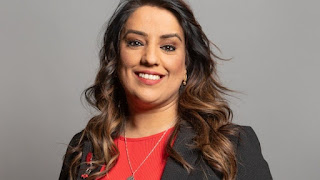


Naz Shah concluded, “When it came to the covid pandemic, this Government played with people’s lives; when it came to levelling up, they played with people’s future; and, again, on the issue of Islamophobia, they are playing with people’s lives. Minister, I urge this Government to show some leadership and good faith. This issue is far too serious to be ignored. As the theme for this year’s Islamophobia month suggests, it is time for change.”

Dr Rosena Allin-Khan 

Labour Member for Tooting. Dr Rosena Allin-Khan, said, “Like many other speakers today, I have my scars. From being attacked by a racist gang in the park with dogs, as me and my brother ran away, having our clothes ripped from us, scared; to the audible gasps of, “Why the hell would you choose to be a Muslim?”, my experiences are as real as they are painful. With a Polish mother and a Pakistani father, and proudly British, I feel fortunate to have grown up immersed in many cultures. I have, sadly, experienced overt racism and bigotry; unfortunately, I have also been where people speak in perceived safety, not realising that I am a Muslim.”

Dr Rosena Allin-Khan said, “When I was studying medicine at Cambridge, a senior surgeon spoke openly about terrorism and Islam. When I asked him kindly to stop, he was shocked. When I stated that I was a Muslim, he asked where I was from and proceeded to tell me that half my family were eastern European cleaners and the other half were terrorists, and that I should go and tell my family to stop killing people.”

Dr Rosena Allin-Khan said, “A taxi driver once told me, 20 minutes into a cab journey, that he would never in his life allow a Muslim into his taxicab. He told me that Muslims were taking over the world, that he had absolutely no desire to meet one, and that he would not allow his daughter to go and study at a university where someone wore a hijab. I told him to stop the car, that he had met a Muslim and that I would continue my journey on foot.”

Dr Rosena Allin-Khan said, “My mum, who is not a Muslim but married one and had two children who chose to be Muslim, is Polish and has blonde hair and green eyes. She has been spat at in the street, called dirty for walking with her children and, while we were growing up, had people shouting at her on the tube, telling her she had married a dirty—I will not name the name, because I do not want to give it a place in this place.”

Dr Rosena Allin-Khan said, “Many people tell me I should have used getting married as the opportunity to drop the Khan and call myself Rosie Allin in a bid to be accepted, and that I should hide all traces of Islam from my daughters’ names, so that they may have “an easier life.” Well, fear will not make me drop my name or my faith, and fear will never stop me fighting against Islamophobia. In this place we have a platform, but millions of people do not. We owe it to them to speak out, and to fight for change for our community and for our children.”

Yasmin Qureshi 

Labour Member for Bolton South East, Yasmin Qureshi said, “I want to set something straight on the record. Bolton South East does not need the help of other MPs to deal with the issues of taxi drivers. I deal with them, meet them regularly and do not need to set up an APPG for them. I am interested to know why no Conservative MP in Greater Manchester ever wants to join an APPG on Greater Manchester, which is much wider. No Conservative MPs will join that. That was rather a silly comment from the hon. Member for Bury North (James Daly) in making that point. To repeat, my taxi drivers do not need any help from anyone else.”

Yasmin Qureshi said, “Returning to the topic of the day, I want to talk about international Islamophobia. In Myanmar, decades of hate speech and persecution culminated in 2017 with more than 700,000 predominantly Muslim Rohingya people having to flee to neighbouring Bangladesh after a vicious campaign of ethnic cleansing; and our Government did nothing about it. In China, close to a million Uyghur Muslims are believed to be interned in so-called re-education camps. There, too, Islamophobia is rife across the country and our Government have done nothing about it.”


Yasmin Qureshi continued, “In India, with every passing year, Islamophobia has become more normalised and mainstream. Narendra Modi was a member of the RSS, a neo-Nazi group, and his Bharatiya Janata party is making India into an authoritarian, Hindu national state. Regular, unprovoked attacks on Muslims by Hindu mobs have become routine in India, along with the destruction of mosques and the taking away of Muslims’ human rights.”

Yasmin Qureshi said, “Last month, the BBC reported that a video had gone viral on social media showing a terrified girl clinging to her Muslim father as Hindu mobs assaulted him. That is not a one-off. That kind of violence is overwhelming. I have never heard a word from the Foreign Office or Government Ministers on that issue. When they talk about wanting to deal with Islamophobia, I would like to hear from the Government.”

Yasmin Qureshi concluded, “In Europe, Muslims are being made the other. Constantly in France and other countries, every time there is a general election, they bring up the subject of Muslims, take women’s veils and bring in new laws that say that Muslims are forming a counter-society. Again, we hear nothing in this country from the Foreign Office. I would like our Government to do something about that.”

Mr Tanmanjeet Singh Dhesi 

Labour Member for Slough Tanmanjeet Singh Dhesi said, “It is a pleasure to serve under your chairmanship, Mr Dowd, and I congratulate my hon. Friend the Member for anchester, Gorton (Afzal Khan) on securing this important debate and on his tireless work. We have been here before many times. Islamophobia is not a new phenomenon but one that has sadly entrenched itself into significant segments of our society. As the Muslim Council of Britain noted, 70% of Muslims have experienced religious-based prejudice in the past 12 months and just under half of all religious hate crimes recorded by police in 2020-21 were Islamophobic. I also highlight that abuse can happen to Muslims or even those perceived as looking like Muslims, such as turbaned Sikhs like myself.

Tanmanjeet Singh Dhesi, “I personally called on the Prime Minister to do more over two years ago, and asked for an apology for his derogatory and racist remarks describing already vulnerable Muslim women as looking like bank robbers and “letter boxes”. Those comments led to a 375% spike in hate crimes and, more widely, showed that to openly abuse Muslim women was acceptable. All that was without an apology, except for a half-hearted one during the heat of an election and only when pressed to do so. That is characteristic of the Government response—denial, delay and avoidance.”

Tanmanjeet Singh Dhesi  continued, “Given the increased prevalence of such Islamophobic incidents in the Conservative party, where is the independent inquiry into Islamophobia, as promised on national television by the Prime Minister and his now Health Secretary? In fact, when the all-party group on British Muslims, of which I am proud to be a vice-chair, agreed on a definition of Islamophobia, all major parties accepted and adopted it with one notable exception: the Conservative party. We cannot simply accept the unacceptable status quo. If we do, we fail millions of Muslims because, without action, this is the message that Muslim communities are hearing.”

Tanmanjeet Singh Dhesi concluded, “ I hope that the Minister, for whom I have time, has come with more than just warm words, because the persistent failure of the Government, particularly the Prime Minister, has real consequences and fails the people of our country.”

Apsana Begum 

Labour Member for Poplar and Limehouse, Apsana Begum said, “Every single day, people of Muslim backgrounds like me face discrimination and prejudice. I am never allowed to forget that my presence in Parliament, as the first MP to wear a hijab, makes many uncomfortable, from the regular mispronunciation of my name to being mistaken for other hijab-wearing women who work in Parliament, to being asked, even, if I am related to Shamima Begum.”

Apsana Begum said, “Too often, we are cynically used as a focal point for people’s anxieties, as scapegoats for the failings of the political and economic system. It should therefore be no surprise to anyone that I constantly have to cope with a vicious torrent of abuse. Just to give hon. Members a few examples, this is the kind of material that I receive: “Vile and filthy religion…importing vile and filthy creatures like Apsana Begum”; “Muslims should be banned from public office…we can’t trust their allegiances”; “Muslims are the masters of lying. They are the bane of our Christian society. They do not belong and should be deported”; “Deport the Filth”; “Throw her and her family back to where they came from”; “Chop her hand off”; “This could be one of your last statements”. Those are not even, by any measure, the worst of what I receive.”

Apsana Begum mentioned, “ All too often, Muslims live with a constant, persistent fear overshadowing our lives, especially given that the latest data shows that Muslims are the largest target of religiously motivated hate crimes. The rise of the far right, in particular, is a very present danger. I just want to pick up on the fact that Government Members have been talking about taking politics out of this. I wonder what they would say to what the UN special rapporteur on freedom of religion or belief reported—that institutional suspicion and fear of Muslims has escalated to “epidemic proportions” and that “numerous” states, regional and international bodies were to blame. Perhaps the Minister can address that point.”

Apsana Begum concluded, ”It is important to remember that, across the world, under the auspices of fighting terrorism and extremism, we see people of Muslim backgrounds facing persecution and the denial of basic citizenship rights, from the Rohingya refugees to the escalated harassment of Muslims in France, for example. The evidence is very clear. Islamophobia is on the rise. But there is hope and I am inspired by the history of anti-racist struggles in east London. I am proud to represent the constituency that I have lived in all my life and I pay tribute to the contributions of Muslims all across Britain.”

Archbishop of Canterbury, Lord Indarjit and Lord Adonis on the Assisted Dying Bill in the House of Lords


The Archbishop of Canterbury, Lord Indarjit and Lord Adonis Oppose the  Assisted Dying Bill in the House of Lords


Dr. Mozammel Haque


Cross Party Peers and All faith Groups of the House of Lords Oppose the Assisted Dying Bill in the House of Lords on 22 October 2021.

The Archbishop of Canterbury on Assisted Dying Bill in the House of Lords


The Archbishop of Canterbury’s contribution on Assisted Dying Bill in the House of Lords on 22 October 2021.

The Archbishop of Canterbury said, “My Lords, I am grateful to the noble Baroness, Lady Meacher, and listened with great attention to her extremely powerful speech. This is an issue on which many of us have personal experiences, often painful and difficult. There is unanimity on these Benches that our current law does not need to be changed, but I know that people of faith hold differing views. No doubt we will hear those today and I look forward to them.”

The Archbishop of Canterbury mentioned, “Everyone here shares the best of intentions. We should recognise that in how we listen and respond to each other. I hope no one will seek to divide the House today, but I welcome the amendment from the noble Lord, Lord Winston, because it draws our focus towards our use of language. We need clarity and precision in our terms.”

The Archbishop of Canterbury said, “Christ calls his followers to compassion, but compassion must not be drawn too narrowly—a point made indirectly and powerfully by the noble Baroness, Lady Meacher. It must extend beyond those who want the law to provide help to end their lives to the whole of society, especially those who might be put at risk. Our choices affect other people. The common good demands that our choices, rights and freedoms must be balanced with those of others, especially those who may not be so easily heard.”

The Archbishop of Canterbury lamented, “Sadly, I believe this Bill to be unsafe. As a curate and parish priest, I spent time with the dying, the sick and the bereaved. I still do. All of us have personal experience; I have as well. We know that the sad truth is that not all people are perfect, not all families are happy, not everyone is kind and compassionate. No amount of safeguards can perfect the human heart. No amount of regulation can make a relative kinder or a doctor infallible. No amount of reassurance can make a vulnerable or disabled person feel equally safe and equally valued if the law is changed in this way.”

The Archbishop of Canterbury said, “All of us here are united in wanting compassion and dignity for those coming to the end of their lives, but it does not serve compassion if, by granting the wishes of one closest to me, I expose others to danger, and it does not serve dignity if, in granting the wishes of one closest to me, I devalue the status and safety of others. I hope your Lordships will reflect and, while recognising the good intentions we all share, resist the change the Bill seeks to make.”


Lord Indarjit Singh of Wimbledon Opposes

The Assisted Dying Bill in the House of Lords


Cross Bench Life Peer Lord Indarjit Singh of Wimbledon opposed the Assisted Dying Bill in the House of Lords on 22 October 2021. He said, “True compassion not only makes life meaningful for both giver and recipient but, importantly, also nudges society as a whole in a more positive ethical direction. It is for these reasons that I oppose the Bill.”

Lord Indarjit Singh of Wimbledon, said, “My Lords, today we live in an increasingly selfish and uncaring society, in which euphemisms such as “assisted dying” for “assisted suicide” and, unbelievably, “compassion” have all been used to justify a Bill that I believe demeans society and pressurises the vulnerable to take their own lives.”

Lord Indarjit Singh said, “The moral slide ahead is clearly visible. In the Netherlands, assisted death is routinely extended to include the disabled, those with chronic, non-terminal conditions and those with mental health problems such as dementia and depression. The suffering of the vulnerable is made worse by those close, making it obvious that their care is an unwanted chore, particularly by some who stand to inherit property or assets. That was highlighted by the noble Lord, Lord Tebbit, who has shown years of loving care and compassion to his injured and disabled wife. During the debate on the 2013 Bill of the noble and learned Lord, Lord Falconer, the noble Lord, Lord Tebbit, said that legislating for assisted suicide “creates too much financial incentive for the taking of life.”[Official Report, 18/7/14; col. 789.]

Such pressures are difficult to pick up by doctors and judges.

Lord Indarjit Singh mentioned, “We are all aware of the problem of climate change, but much less aware of a deteriorating moral climate—a growing selfishness seen in daily news of violence against the weak and vulnerable.”

Lord Indarjit Singh of Wimbledon said, “Assisting in the killing of our fellow human beings has been condemned by leaders of all our major faiths, including, as we have heard, the most reverend Primate, the Archbishop of Canterbury. Statistics remind us that it is not physical pain but a feeling of being unwanted and a burden on others that leads to mental suffering and a wish to die. We have heard conflicting stories about the different views of religions. In the story of the good Samaritan, Jesus Christ reminds us of our common responsibility to help in alleviating the suffering of our fellow beings. In Sikhism, the young Guru Nanak spent money given by his father for investment on food for the starving. Loving care for others, even to the enemy in battle, is central to Sikh teaching.

Lord Indarjit Singh of Wimbledon concluded, “Finally, I mention the misuse of the word compassion —unbelievably, used to advance the Bill. The literal meaning of “compassion” is to show in loving care that we understand and share in another’s suffering. True compassion not only makes life meaningful for both giver and recipient but, importantly, also nudges society as a whole in a more positive ethical direction. It is for these reasons that I oppose the Bill.”

Labour Peer Lord Adonis On

Assisted Dying Bill In the House of Lords


Labour Peer Lord Lord Adonis’s contribution on Assisted Dying Bill in the House of Lords on 22 October 2021.

Labour Peer Lord Adonis opposed the Assisted Dying Bill. He said, “My Lords, I am opposed to this Bill, although I accept that it is a desperately difficult issue; like other noble Lords, I have heart-rending experiences of the long, drawn-out deaths of friends and relatives.”

Labour Peer Lord Adonis said, “The problem with the Bill is that it is simply not possibly to guard adequately against the abuse of the very elderly and the very ill by greedy and manipulative relations and friends. The idea that brief consultations with two doctors are adequate is simply not credible. I accept that it does extend autonomy—autonomy which I might personally value—to those of sound mind who are unpressurised about ending their life. Of course I accept that, which is why this is such a desperately difficult issue. But the supreme duty of the state and the community is to protect the vulnerable and their human rights. There is no greater human right than the right to life. Therefore, very reluctantly, I come to the conclusion that this Bill—or indeed any Bill seeking to achieve this objective—is not one to which Parliament should give assent.”


Monday, 29 November 2021

Muslim MPs discuss Stories of Islamophobia in the British Parliament


MUSLIM MPS SHARE SHOCKING STORIES

OF ISLAMOPHOBIA, URGE TORIES TO ACT


Dr Mozammel Haque

Followings are the report by the Islam Channel on the Debate on Islamophobia in the Westminster Hall of the House of Commons in the British Parliament on 24 November 2021.

“Muslim MPs shared their experiences of Islamophobia in a heated Commons debate on the topic on Wednesday.

In the one-and-a-half-hour debate, MPs from various parties demanded the Conservatives accept the All-Party Parliamentary Group (APPG) on British Muslims' definition of Islamophobia and engage with the Muslim Council of Britain (MCB) again.  

But the debate turned into a row with the Conservatives protesting that it had become political — the Tory Equalities Minister Kemi Badenoch accused the other parties of turning the issue into a “political football”.

SNP MP Anum Qaisar responded by saying she tore up her planned speech to instead talk about her lived experience of facing Islamophobia: “I was nine years old when I was asked if my dad was a terrorist the day after 9/11."

"To be perfectly frank, I will not accept a debate in which we are told that we have to take the politics out of it, because the Prime Minister peddles dangerous rhetoric when he says that veiled Muslim women look like “letterboxes”. I am a Muslim. I know how that feels" added Qaisar.

MPs share their lived experience

Labour shadow minister Rosena Allin-Khan revealed how she was attacked when she was 11.

"Like many other speakers today, I have my scars. From being attacked by a racist gang in the park with dogs, as me and my brother ran away, having our clothes ripped from us, scared; to the audible gasps of, “Why the hell would you choose to be a Muslim?”, my experiences are as real as they are painful," she said.

Apsana Begum, Labour MP for Poplar and Limehouse, talked of being the first hijabi MP and how that makes some people uncomfortable: "From the regular mispronunciation of my name to being mistaken for other hijab-wearing women who work in Parliament, to being asked, even, if I am related to Shamima Begum."

She added: "This is the kind of material that I receive: “Vile and filthy religion…importing vile and filthy creatures like Apsana Begum”; “Muslims should be banned from public office…we can’t trust their allegiances”; “Muslims are the masters of lying. They are the bane of our Christian society. They do not belong and should be deported”; “Deport the Filth”; “Throw her and her family back to where they came from”; “Chop her hand off”; “This could be one of your last statements”. Those are not even, by any measure, the worst of what I receive."  

The debate was secured by Afzal Khan, Shadow Leader of the House and Chair of the Labour Muslim Network, who pointed out the importance of defining the problem as it is the "first step in rooting it [Islamophobia] out."

Both Khan and Labour MP Bell Ribeiro-Addy also questioned the government's controversial appointment of William Shawcross to head a review of its anti-radicalisation scheme Prevent. Shawcross is accused of having a "hostile view of Islam and Muslims."

"The appointment of William Shawcross is just a symptom of something that must be addressed in this debate: the Conservative party’s Islamophobia crisis," said Khan.

Other Muslim MPs talked about the wide-ranging issues that stem from Islamophobia.  

Labour's Yasmin Qureshi mentioned Islamophobia in other countries, while colleague Naz Shah highlighted the media's role in fuelling Islamophobia and how it results in unconscious bias.

"A sizeable percentage of British Muslim women do not wear the headscarf, not because they do not want to but because they fear that, by wearing one, they may be attacked, or due to prejudice, will have lower chances of succeeding and reaching the top," said Shah.

MPs from all sides underlined the positive impact and contribution of Muslims to wider society, from running soup kitchens to playing an active role in community initiatives.

Heated debate


MPs addressed the defensive tone of the comments from the Conservative Party.

SNP deputy leader Kirsten Oswald said: "The tone of some of the comments opposite was really regrettable today... And some of the eye rolling and the language used was most unfortunate."

Meanwhile, Lib Dem MP Wera Hobhouse said she was "disturbed by the initial aggression of some Tory members in this debate."

"We need to listen to those who have lived that experience and recognise it as hurt and not call it politics that is wrong," she added.

But many welcomed the "reasoned" contributions from Conservative MPs Anthony Higginbottom and Steven Baker.

Baker mentioned how he is "viciously trolled by Islamophobes" whenever he stands up for his British Muslim constituents. He urged the government to meet with the MCB and the APPG on British Muslims to accept a definition of Islamophobia.  

The Tories have a policy of not engaging with the MCB.  

"It’s been a very feisty debate and it’s quite clear that concerns about anti-Muslim hatred transcend party lines," Badenoch opened her speech with.

She said she would meet the APPG officers and listed what the government is doing to tackle Islamophobia. " I'm not afraid of using the phrase Islamophobia. We're not going to have a semantic argument. But there are good reasons why we refer to anti-Muslim hatred," said the Tory minister.  

Badenoch admitted that “things have been slow” when it comes to acting on Islamophobia, adding that there will be "a different change of tone and pace with me as faith minister."

A few MPs talked about the conflation of terrorism and Islam in discussions. Later in her speech, Badenoch said the murder of Sir David Amess and added that it was done by "someone claiming to act on behalf of Islam."

Qureshi chastised Badenoch for adding that line: "She started her speech by using a trope about Muslims and terrorism, yet she is meant to be talking about Islamophobia."

Acknowledgement: Islam Channel

Courtesy@Islam Channel